





北京乐成学校幼儿园:一间没有“标准作品”的教室,却是童真创造力生长的“心脏”
Where Creativity Comes to Life


在近期全球教育发展领域的畅销著作《Finding Our Way: Developing a Shared Pedagogy》中,来自国际学前与小学教育领域的知名教育者Fiona Zinn与Anne Van Dam,分享了其多年来在全球范围内的教育实践与深度观察,为全球教育者提供了重要参考。其中,一所来自北京的国际幼儿园案例被收录其中——这正是位于北京CBD的北京乐成学校幼儿园(BCIS Early Childhood Center, ECC)。
在这所真正意义上的“儿童之城”,富有生命力的教学与学习场景随处可见,而“创造力实验室(Materials Lab)”正是其中最具代表性的空间之一。
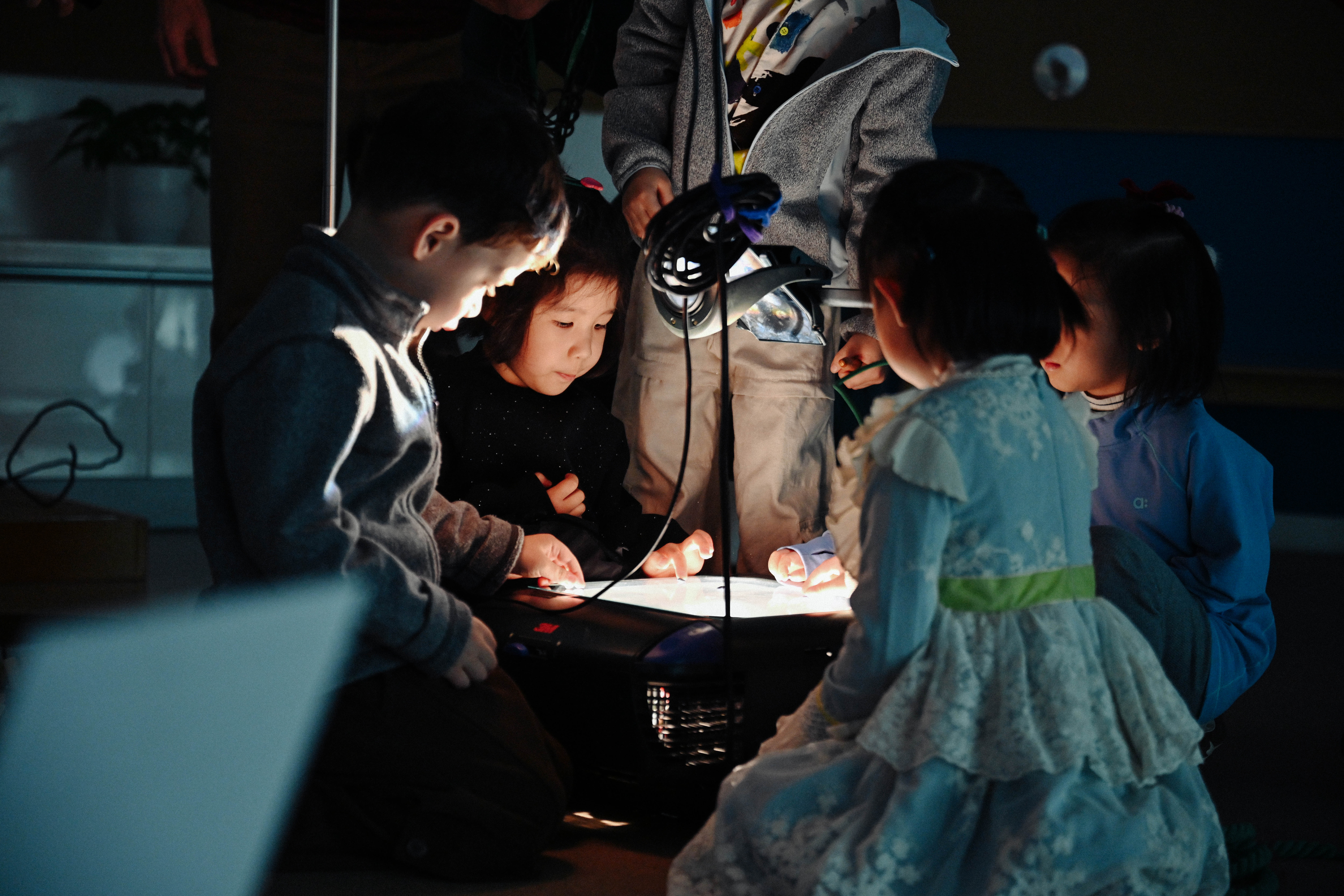
走进幼儿园二楼,你会遇见这间有些特别的教室:没有整齐陈列的精致“成品”,也没有统一模仿的创作范例。取而代之的,是纸筒、木块、绳子、镜子、气泡膜、滴管……这些看似寻常的材料,被自然地安放在空间之中,等待孩子去触碰、尝试,并重新赋予意义。
它并非传统意义上的美术教室,而是一处让孩子借助材料表达想法、发展思考、逐步理解世界的学习场域。在这里,持续发生着“研究”——孩子、教师以及国际早期教育专家共同作为学习的合作者,在观察、提问与反复尝试中建构理解。
也正因如此,它更像幼儿园的“心脏”,让好奇与探究的脉动,持续地流动于整个园区。
国际早期教育专家共研
看见儿童如何思考
作为一片由孩子、教师与早期教育专家共同发展的学习空间,不久前,来自澳大利亚的国际早期教育专家 Kirsty Liljgren 再次走进创造力实验室,与教师团队展开了深入的共研。这一次,我们将关注点聚焦在一种看似简单却意义深远的表达方式——绘画与“痕迹表达”。
“痕迹表达与绘画,在儿童学习中扮演着极其重要的角色。当孩子第一次留下痕迹的那一刻,其意义是深远的——‘这是我创作的,是我留下的痕迹,并且它可以被保留下来。’这一刻,孩子让“自我”变得可见。他们所接触和使用的材料,会不断激发想法与故事,形成属于自己的“理解”。通过痕迹表达,孩子不仅在呈现所见,更在建构理解,激活思考。”
——Kirsty Liljgren,全球早期教育咨询顾问,每年定期到访北京乐成学校幼儿园,通过培训与深度合作,聚焦材料探究与学习环境的创设,激发儿童更深层的学习好奇心与内在驱动力。
我们始终相信,孩子理解世界的方式是多元的。语言不仅存在于“说”与“写”,也流动在于绘画、雕塑、戏剧、音乐、舞蹈、建构、游戏之中,而视觉语言,往往是最早出现的一种表达方式。
在这一周的共研中,孩子们用不同材料去“表达”:他们不仅在纸上作画,也在瓷砖、镜面、气泡膜等表面留下痕迹;他们感受材料之间细微的变化,也在反复尝试中逐渐形成自己的图像与意义。
在这样的环境中,痕迹不再只是“画”,而更像是一场发生在材料与动作之间的对话。当孩子用图画讲述故事时,呈现的不只是形象,更是他们对世界的理解与猜想。
当我们问:“树木是如何知道什么时候开花的?”孩子们并未急于寻找标准答案,而是用图画去回应:有的画出太阳在“提醒”树木,有的想象树木彼此“交流”。这些表达既带着童真温柔又奇妙想象,也承载着他们正在生成中的世界观。
在持续一周的工作中,我们看见孩子在不被打断的状态下,如何逐渐深入、延展想法,并沉浸于思考本身。而在教师的观察与回应中,那些细微却深度的学习与思考,也被我们真实地看见与理解。
让材料参与其中
激发与延展儿童的想法
在本次的探究中,我们自然会追问:是什么支持了孩子表达的发生?答案之一,正是材料。
我们引入了大量并非传统意义上“绘画工具”的材料——水、滴管、喷瓶、不同质地的基底(如黏土砖、石板、镜面)……这些材料的加入,让表达不再局限于单一方式,而成为一段可以被不断展开的探索旅程。
在ECC,我们始终重视“材料”的教育价值。
在创造力实验室中,材料不仅被丰富地提供,更被有意识地组织与呈现。除了画笔与颜料,我们还陈设诸如弹珠、纸杯、木块、塑胶水管、丝带、旧报纸等开放性材料。它们没有既定用途,也不预设结果,而是以开放的方式邀请孩子使用与延展思考。
材料并非被动工具,而是思考的参与者。它们回应孩子的动作,激发新的问题,也不断拓展认知边界。当孩子与材料长时间相处时,他们不仅是在“玩”,更是在理解材料本身:一根绳子可以成为桥、边界或路径;一个纸箱,可以是房屋、交通工具,也可以通向想象世界。
与此同时,学习也在关系中发生。当孩子围绕材料展开交流,他们开始协商、倾听彼此的想法,并激发彼此的灵感。学习不再只是个体行为,而是在互动中不断生成的过程。
教师在其中的角色,是陪伴与支持:观察孩子如何行动、提出怎样的问题,并在适当时刻引入新的线索,让他们与声音、自然、重力或测量等经验建立连接。更重要的是,让孩子意识到——原来,我可以如此有想法,可以表达出来。
这样的学习不会止步于创造力实验室,这片空间更像一颗持续跳动的“心脏”,将探究的脉动延伸至整个园区。
当您走进ECC的教室,或许会留意到一个有趣的现象:这里几乎没有传统意义上的“玩具”。这并非资源的缺失,而是一种有意识的教育选择。成品玩具往往自带唯一或有限的玩法与结果,也在无形中限定了想象的方向。因此,我们更愿意为孩子提供一个由开放性材料构成的园区环境,让他们不被既定路径牵引,而是勇敢地开启无限想象。
回到早期教育本质
从童真的创造力出发
创造力实验室的诞生,源于一个朴素却坚定的信念:孩子,本就带着丰盈的想法而来。
“在多次与ECC教师团队于材料实验室的合作中,我深切感受到,这是一个极为独特的学习空间。在这里,教师得以持续探索孩子的学习方式,并在实践与反思中不断加深理解。从创造力与创新的视角来看,在全球范围内,能够以‘材料’为核心构建学习环境,同时关注多模态学习与创造力发展的学校,仍然十分少见。”
——Kirsty Liljgren,全球早期教育咨询顾问
因此,这里并不是一个以“产出作品”为目标的空间,而是一片允许思考缓慢发生的场域。它贴近孩子真实的学习方式——通过接触材料、反复尝试、构建理论,在过程中稳步且深入地生成理解与知识。我们并不急于看到一个由成人标准定义的“完整”或“精致”的结果,而是将目光停留在学习发生的过程本身:孩子长时间专注于某种材料时的沉浸状态,他们在表达与凝视中不断闪现的灵感,以及那些在一次次尝试中逐渐浮现的、奇妙而动人的理解。
没有范本,也没有必须抵达的终点。知识与意义,不被直接给予,而是在互动中生成。孩子——是学习真正的建构者。
“回到早期教育的本质,我们的工作从来不是教孩子‘如何思考’,而是看见——思考,本就如何在他们身上自然发生。我们持续关注孩子如何探索材料,如何理解世界。我们不告诉孩子该想什么,而是更关心他们正在想什么。这正是幼儿教育最有趣、也最有价值的部分。”
——Jackie Becher,北京乐成学校幼儿园园长
对ECC而言,这个空间既是实践的呈现,也是一次次“自我提醒”:孩子不是等待被填充的容器,而是天生具备能力的学习者。他们有着美丽独特的视角,也有不断展开的想法。因此,我们的工作,始终从这里出发——去遇见真实的孩子,跟随他们的好奇,回应他们的探索,并在尊重之上给予专业支持,让思考得以延展。
这,正是创造力实验室长久而深远的意义。

In the widely recognized Finding Our Way: Developing a Shared Pedagogy, early years education experts Fiona Zinn and Anne van Dam draw on years of global research and practice to explore how children learn. Among the international case studies featured in the book is one from Beijing—BCIS Early Childhood Center (BCIS ECC), located in the heart of the city’s CBD.
At the ECC, learning is visible, lived, and deeply embedded in children’s everyday experiences. One space, in particular, brings this approach into sharp focus: the Materials Laboratory.
Located on the second floor, the Materials Lab may at first feel unfamiliar. There are no rows of polished, identical “finished” artworks. No templates. No model examples to copy. Instead, the space is filled with materials—cardboard tubes, wooden blocks, rope, mirrors, bubble wrap, pipettes—everyday objects thoughtfully arranged and waiting to be explored, tested, and transformed into something entirely their own.
This is not an art room in the traditional sense. It is a space where children use materials to express ideas, develop theories, and create and make sense of the world. Here, learning unfolds as an ongoing process of inquiry. Children, teachers, and visiting early childhood experts work together as co-researchers—observing, questioning, revisiting, and building understanding over time.
In this way, the Materials Lab functions much like the “heart” of ECC—quietly and continuously circulating curiosity, exploration, and thinking throughout the center.
Seeing How Children Think
As a space shaped collaboratively by children, teachers, and international educators, the Materials Lab is also a site of ongoing pedagogical research. Recently, early childhood consultant Kirsty Liljegren returned to ECC to work alongside the teaching team. This time, the focus centered on a seemingly simple yet deeply meaningful form of expression: mark-making and drawing.
“Mark making and drawing have such an important role in children’s learning. Just imagine it from a young child’s point of view—the first time they are mark making: ‘I made that. I did that, and it is permanent.’ In that moment, the child makes part of who they are visible. The materials they encounter act as activators of the learning process. A mark can suggest an idea—a line that becomes a journey, a map, an adventure—generating stories, narratives, and theories. Through mark making, children are not only representing what they see; they are constructing understanding and activating their thinking.”
——Kirsty Liljegren, Global Early Learning Consultant and Educator
At ECC, there is a shared understanding that children’s ways of knowing are inherently multimodal. Language does not exist only in words—it moves through gesture, action, play, and image. Graphic expression is often one of the earliest ways children begin to communicate their thinking.
Over the course of the week, children explored mark-making across a wide range of materials and surfaces. They drew not only on paper, but on concrete, tiles, mirrors, and textured materials such as bubble wrap. They observed how marks shifted depending on the surface, how materials responded, and how their own gestures shaped what emerged.
In this context, marks become more than drawings, as they become traces of thinking, part of an ongoing conversation between material and action.
When invited to consider questions such as, “How do trees know when to bloom?” children did not search for a single correct answer, but instead responded through images and ideas: some imagined the sun “telling” the trees when to grow; others suggested that trees might communicate with one another.
These representations reflect children forming hypotheses, testing ideas, and constructing meaning. Through drawing, children make visible what might otherwise remain unspoken.
Over time, what becomes evident is not only what children create, but how they sustain attention, revisit ideas, and deepen their thinking when given uninterrupted time. Through careful observation and thoughtful response, teachers are able to notice and support these subtle yet significant shifts in understanding.
Materials as Partners in Thinking
This naturally leads one to wonder: what makes this kind of expression possible? One important answer lies in the role of materials.
In the Materials Lab, materials extend far beyond convention al art tools. Water, pipettes, spray bottles, and a range of surfaces—clay tiles, stone, mirrors—are intentionally introduced to expand how children explore and express ideas.
At the ECC, materials are seen as active participants in learning instead of just passive tools.
They are carefully selected, organized, and presented to invite curiosity, exploring and encountering open-ended materials such as marbles, paper cups, wooden blocks, plastic tubing, ribbons, and recycled paper. These materials come without instructions or predetermined outcomes, but instead inviting interpretation and imagination.
A piece of string might become a bridge, a boundary, or a path. A cardboard box might transform into a house, a vehicle, or an imagined world. As children spend extended time with materials, they end up investigating properties, testing possibilities, and building relationships with the physical world.
Learning here is also deeply social. As children gather around materials, they exchange ideas, negotiate meanings, and adapt their thinking in response to one another. Knowledge is not constructed in isolation but emerges through interaction.
Within this dynamic, the teacher’s role is both subtle and intentional: to observe closely, to recognize emerging questions, and to introduce new perspectives or materials at just the right moment, connecting children’s explorations to concepts such as sound, nature, gravity, or measurement.
Perhaps most importantly, this process allows children to arrive at a powerful realization: my ideas matter—and I can express them.
The influence of the Materials Lab extends well beyond its walls. Like a living system, its rhythms of inquiry ripple outward, shaping the culture of learning across ECC.
Visitors often notice something unexpected: the absence of traditional toys. This is not a lack of resources, but a deliberate pedagogical choice. Many ready-made toys come with predefined uses and outcomes, subtly limiting imagination. Open-ended materials, by contrast, create space for thinking, for invention, and for possibility.
Beginning with Children’s Innate Creativity
The Materials Lab begins with a simple belief: children arrive full of ideas.
“I have deeply felt that this is a truly unique learning space. Here, teachers are able to continuously explore children’s ways of learning and deepen their understanding through practice and reflection. From the perspective of creativity and innovation, on a global scale, it is still quite rare to find schools that construct learning environments centered on ‘materials,’ while also focusing on multimodal learning and the development of creativity.”
—— Kirsty Liljegren, Global Early Learning Consultant and Educator
Designed as a space for thinking-in-the-making, it is grounded in how young children actually learn: through touch, trial, revision, and imagination. At the ECC, emphasis is not on producing something polished or complete, but on the living process of exploration. We pay attention to the moment a child lingers with a material, the spark of an idea as it forms, and the quiet persistence of trying again, differently.
In the absence of templates to follow or predetermined outcomes to achieve, students begin to realize that their own thoughts are among their most valuable assets. When teachers resist telling children what to think, meaning is no longer handed to them — it becomes something they actively construct for themselves.
“The BCIS ECC Materials Lab is a very special place. It acts as the heart of our center, enabling research, curiosity, and inquiry to spread throughout. This is a space where children’s imagination, creativity, critical thinking, and problem-solving can thrive. Teachers do not have in mind what children will create; rather, we are interested in how they explore materials, the theories they develop, what these mean, and how they are making sense of the world. That is what is truly interesting about young children—and what makes our education different.”
——Jackie Becher, BCIS Early Years Principal
At its heart, early childhood education is not about directing how children should think, but about noticing how thinking is already unfolding. The Materials Lab lives in this space of attentiveness, serving as a space for ongoing practice of listening with care, observing with intention, and treating children’s thinking as something worthy of time and respect.
For the ECC team, this space is a reminder that children are not empty vessels to be filled, but capable learners, each with their own ways of seeing and making sense of the world. Their ideas are layered, their imaginations expansive, their questions deeply genuine.
Our work begins there—by meeting each child as they are. By following their curiosity, responding to their explorations, and offering just enough guidance to extend their thinking without closing it down. In this way, we bring the BCIS mission to life: to challenge and empower students to become inspired and compassionate individuals with a genuine sense of agency.
This is the purpose of the Materials Lab—a space that continually reconnects us to our mission and reminds us that meaningful learning begins with curiosity, choice, and the freedom to think for oneself.

