





园长说|中英并重,双向滋养—乐成学校幼儿园早期语言学习这样发生
ECC Language & Literacy Learning


自2014年开园以来,十年间,北京乐成学校幼儿园(BCIS Early Childhood Center)始终扎根于城市核心地带,与北京乐成学校主校区的教育基因一脉相承。作为一所专业化、国际化、面向未来的幼儿园,我们拥有一支始终站在国际早期教育前沿的教师团队,致力于为每一位孩子营造一个多元、关爱、富有全球视野的成长环境。
我们相信,每一个孩子都值得拥有一段被尊重、被赋能、充满探索与惊喜的童年旅程。而这段旅程的起点,往往始于家庭的教育选择。因此,“家校共育”不仅是ECC的重要特色,更是我们教育理念的核心组成部分。
为回应越来越多家庭对早期教育的关注,我们特别推出“园长说”专栏,分享我们在课程设计、教学实践及儿童发展方面的深入探索与真实体会。希望这些来自教育一线的故事与经验,能陪
这些问题背后,是家长们对孩子语言发展最真实的关切。
在乐成学校幼儿园,语言与识读素养的培养始终是教育的重点。我们以贴近儿童认知方式的真实情境,引导他们在探索中习得语言,从而在校园内外的多元环境中自如灵活地使用语言。
研究表明,一个孩子母语的根扎得越深,他们在第二语言中成长得就越稳。联合国教科文组织在推广母语教育时也引用了大量研究数据,进一步印证了母语基础对第二语言学习具有积极的促进作用。
在乐成学校幼儿园,除外籍主班教师外,每位孩子都会与经验丰富的中方教师共同学习。中方教师不仅仅是“中文的传授者”,更是孩子走向英语世界的重要桥梁。许多孩子入园时以英语为第二语言,家庭也普遍希望孩子在提升英语能力的同时,保有并发展中文表达力,建立文化认同,成为真正的双语使用者。
因此,中方教师肩负着跨文化连接的责任。他们帮助孩子理解如何成为具有全球视野的公民——不仅掌握语言,更理解其背后的文化内涵,逐步发展跨语言、跨文化的理解与表达能力。
在幼儿园,中文教师与外教不是各自独立授课,每周,他们会与课程协调员共同制定教学计划,重点围绕语言学习展开讨论,分享孩子在语言与识读方面的发展观察,并据此设计丰富的语言探究活动。这样的协作确保了孩子们始终保持对语言及其口语、书面形式的浓厚兴趣。
这一教学方式在实际课堂中有着丰富多样的呈现形式。例如,最近一个班级的孩子对“如何让我们的表达更有趣”产生兴趣。教师敏锐捕捉到这一契机,决定带领孩子们探究“形容词”这一概念。课程协调员建议,由于孩子们对中文中形容词的理解还较为初步,首先需要深入探究这个概念。老师们精选了大量富含形容词的中文绘本进行共读,引导他们像作家一样去阅读和思考。很快,孩子们便能识别出那些令文字生动的形容词,并开始尝试用这些词描绘月亮、泡泡、动物等事物。
在这一过程中,孩子逐步建立了中文语言的知识基础,理解语言的结构和运作逻辑。这也为后续在英语中学习相同概念奠定了坚实基础。当老师在英文课堂引入形容词时,孩子们表现出出色的迁移能力,能迅速识别英文形容词,甚至尝试将中文词汇主动翻译为英文。
我们深知,孩子的语言学习过程中常会经历“语言转换”(translanguaging)或“脑中翻译”的阶段。中方教师会有意识地进行“思维示范”,引导孩子将语言转换内化为一种思维方式。例如,教师可能会说:“我在想这个词怎么翻译更合适,有哪些可能的说法呢?”
孩子们会积极参与讨论,教师则引导他们判断哪种表达更贴切,并解释其背后的语言逻辑。比如,“不规则的泡泡”一词,孩子可能会说成 no regular bubble。 而老师说道,“虽然直译没错,但在英语中,irregular bubble是更准确的表达。"
这种深度的语言探究,正是ECC课堂的日常缩影。
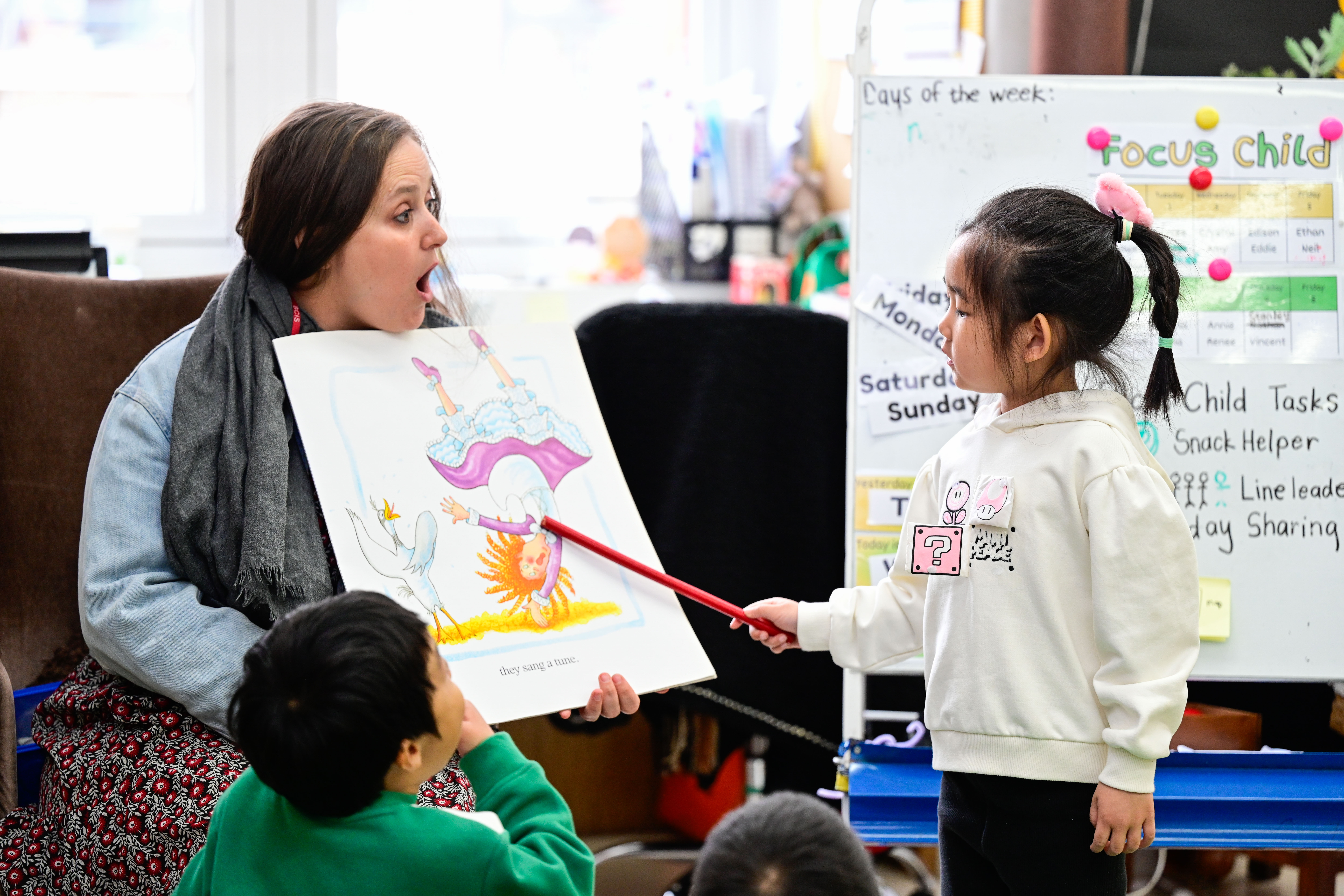
在小班和小小班阶段,语言学习同样以自然的方式进行。孩子们会用中英文演唱同一首歌曲,阅读同一本绘本,并通过“故事桌”这一富有创意的工具进行语言表达。他们先用中文复述熟悉的故事,在教师引导下逐步尝试用英文表达。这种方式自然流畅,是一种有效的帮助语言能力发展的方式。
当孩子们从幼儿园升入小学时,往往已具备良好的中英文沟通能力,能够自如地切换和运用两种语言。他们的语言学习没有压力,也不焦虑,而是在探索中不断发现语言的乐趣与魅力。他们热爱语言,敢于表达,对语言的规则和差异有着深入理解,因而具备了更加自信、精准的表达能力。
在乐成学校幼儿园,我们不急于用简单的“中英文教学比例”来回答家长的问题。对我们而言,真正重要的是:孩子是否在真实、有意义的情境中,让语言真正“活”起来。语言学习的价值,在于能否帮助孩子建立中英双语之间的思维转换能力,是否促进他们对不同文化表达方式及其背后逻辑的理解,更在于,能否让他们在多元文化的语境中,自信表达自我,理解并尊重他人。
语言从不是一门孤立的学科,它富有游戏性、基于探究,同时保持高度的教育严谨性。在我们看来,中英文的学习同等重要。这是一种深度、持续的语言积累过程,更是孩子迈向终身学习的坚实起点。

Since opening in 2014, the BCIS Early Childhood Center (ECC) has been deeply rooted in the heart of Beijing, proudly aligned with the values and educational philosophy of the main campus of Beijing City International School. As a professional, international, and forward-thinking kindergarten, ECC is home to a dedicated team of educators who are at the forefront of early childhood education. Together, we strive to create a nurturing, inspiring, and globally minded environment where every child can thrive.
We believe that every child deserves a childhood that is respected, empowered, and full of wonder and discovery. For many families, this journey begins with their first educational choice. That’s why we place great value on the partnership between home and school—a hallmark of the ECC experience and a cornerstone of our educational approach.
In response to the growing interest in early childhood education—and to share our thinking around curriculum design, teaching practice, and child development—we are proud to introduce Kindergarten Corner: An Educator’s Column series. Through this platform, we aim to offer insights and stories from the front lines of education, supporting families as they embark on the early learning journey and helping make each step forward one of confidence and clarity.
Language and Literacy learning in our early years program is a priority. Our children learn and inquire into language in authentic ways that make sense to each child, so they are able to use language in many different settings beyond school.
The Early Childhood Center is staffed to encourage Chinese and English language development. Every child has access to a Chinese Teacher. The Chinese Teacher facilitates children’s Chinese language learning. They also have another role—the key difference in how our Early Childhood Center teaches language—the Chinese teachers use Chinese as a bridge into English. We understand for most children, English will be their additional language, different to their home language. We also understand families desire for children to be bilingual and proud of their Chinese heritage, something which our Chinese teachers intimately understand. Our Chinese teachers show our children how to be global citizens and how to navigate, translate and learn not just language, but also culture.
Our teachers work in partnership with our foreign teachers to teach language, having time to plan together with our Curriculum Coordinator each week. Discussions at the ECC regularly center around language learning. Often the teachers will discuss their thoughts about what they see from the children’s language and literacy learning. They will use this to suggest different pathways the children might inquire into. Teachers work together to develop language and literacy inquiries, ensuring children remain curious about language and how it works in spoken and written form.
How this looks varies, of course. One class recently were interested in how they could make their writing more interesting. The teachers decided that inquiring into describing words or adjectives might be a possibility. Our Curriculum Coordinator discussed with teachers that the children may not be familiar with the concepts of adjectives in Chinese, so we need to research that first. So, the teachers worked with the children to test this theory and began to select books that had many adjectives in Chinese to use with the children. As our children know how to “read like writers”, the children quickly discovered that the adjectives made the text more interesting. They went on a quest to finding adjectives to describe lots of things—the moon, bubbles, animals… The teachers were building the children’s knowledge of language and how it works in Chinese, knowing that if the children understood this well, that learning and using this concept in English would be easier.
When the teachers did introduce the concept in English, it was easy for the children to understand. Children not only quickly identified adjectives in English, they also were able to translate words from Chinese to English. We understand that children go through a process of code-switching or translating the words in their heads. Our Chinese staff intentionally show children how to do this by verbalizing their thinking processes.
For example, the Chinese teachers might say to children: “I wonder how to best translate this word in Chinese or English. It might have several possibilities.” The children and teachers will discuss this together, gaining input from all teachers about what is the best fit word, words, phrases. Teachers use language like, “I think in this context, this translation, word, phrase is better,” and will explain to the children why. For example, when the children directly translated a certain phrase as “no regular bubble”, the teachers explained how this was correct in terms of direct translation, however in English, a stronger translation would be “irregular bubble”. This is deep learning BCIS ECC children are exposed to regularly in an authentic way.
This sees children quickly not only develop words in English, but also understand how the rules of the languages and different; and what to do when translating.
Similarly, children in our Toddler and Nursery programs, sing the same song or read the same book in English and Chinese; and use story tables. Story tables enable children to tell a familiar book in Chinese, and then, with assistance, begin to retell the story in English. It is a natural way for children to develop both languages.
Our children go to Elementary School as competent Chinese and English learners, who are able to navigate and use both languages, doing this without pressure or stress. Our children love language; they love language problem solving; and they deeply understand the rules of Chinese and English, how they differ. Our children are empowered in how they use language as a result.
This learning is rich. This learning sticks. This is lifelong learning. These are skills children will use for life and will not leave them. Language learning in the Early Childhood Center is playful; it is grounded in inquiry; it is rigorous. Chinese and English language learning is important to us.

